
If you have come across EMS Training, you have probably also come across its marketing. Faster results. Less time. A session that works harder than a conventional workout. Some of that is grounded in something real. Some of it is not. And if you are a busy professional trying to decide whether it is worth your time, the gap between the two matters.
The more useful question is not whether EMS sounds impressive. It is what it can actually do for you, with realistic expectations and an honest look at what the evidence says.
The answer is more grounded and more encouraging than either the marketing or the scepticism tends to suggest.
What EMS Training Actually Involves
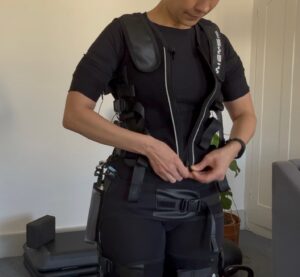
EMS Training uses electrical stimulation across multiple major muscle groups while you perform simple movements or exercises. That last part is worth knowing upfront: it is not a passive treatment. You are still training. The stimulation increases the muscular demand of the session, meaning a shorter, supervised workout can produce a greater physical challenge than the movements alone would suggest.
For many people, that is exactly the appeal. A structured session with direct coaching, without the complexity of planning your own gym programme or the time cost of a conventional training block. The technology is not the point. The question is whether it produces real results, and on that, the current evidence is clearer than it used to be.
What Research Says About EMS Training for Strength
The most robust research support for whole-body EMS is in muscle mass and strength, particularly in non-athletic adults.
A 2021 systematic review and meta-analysis found significant improvements in muscle mass and strength in predominantly untrained, middle-aged to older adults (Kemmler et al., 2021). That is worth sitting with for a moment, because it tells you something specific: WB-EMS appears most credible not as a universal performance enhancer, but as a practical strength stimulus for adults who want an efficient, guided route into resistance training. Which is most of the people who actually use it.
A 2024 evidence map across 86 longitudinal WB-EMS trials in non-athletic cohorts described the approach as time-efficient, joint-friendly, and highly customisable (Beier et al., 2024). The evidence base has grown substantially. This is no longer a speculative conversation. The question is not whether WB-EMS can produce real strength adaptations. It is whether it is the right fit for you.
Who EMS Training Seems to Help Most
Being honest about this actually makes the case stronger, not weaker.
The clearest results from WB-EMS research appear in people who are non-athletic, middle-aged or older, who have returned after a gap, or who find conventional resistance training difficult to access or sustain. If that sounds like you, or like where you have been for the past year or two, that is worth knowing.
A 2024 systematic review in active young adults found that EMS Training does not produce superior results compared to other training methods in that group (Burgos-Postigo et al., 2024). So if you are already training consistently and well, EMS is unlikely to dramatically outperform what you are already doing. But if you are someone who has been struggling to make strength training stick because of time, confidence, joint issues, or simply not knowing where to start, the evidence suggests it can genuinely help.
The honest case is not that EMS beats everything else. It is that it helps certain people do productive strength work who might otherwise do very little at all. For those people, that is a meaningful difference.
Can Short EMS Training Sessions Still Build Strength?
If you are time-poor, this is probably the question that matters most to you.
A randomised controlled study found that once-weekly 20-minute WB-EMS sessions over 16 weeks improved both strength and lean body mass in a healthy adult cohort (Zink-Ruckel et al., 2021). That is not the optimal dose for everyone, and as with any single study, the population context matters. But it suggests that meaningful adaptation can happen in less time than most people assume — as long as the training is properly structured and you actually show up for it.
That matters because it supports something worth saying plainly: the body does not care how long you spent in a gym. It responds to sufficient stimulus, delivered consistently. For someone whose realistic alternative is no structured resistance work at all, a well-designed shorter session is not a compromise. It is a legitimate and evidence-supported place to start.
Why EMS Training Can Work Well for Busy Professionals
For most busy professionals, the problem with conventional training is not any single obstacle. It is the accumulation of small ones.
The time to travel. The decision fatigue of planning your own sessions. The ease of quietly skipping when the week gets difficult. The nagging uncertainty about whether what you are doing is actually working. A shorter, supervised format addresses several of those at once. The session is structured for you. The time is defined and contained. The coaching is built in. There is far less room for it to slide off the week.
That does not make it effortless; it still requires training, effort, and consistency to produce results. But in the long run, a method you actually sustain is worth more than the theoretically better plan you keep putting off. That is one of the things WB-EMS genuinely offers, and it is more valuable than it might sound.
What EMS Training Does Not Do as Well
It is worth being straightforward about this because it will help you set the right expectations.
The strongest evidence for EMS is in muscle strength. The evidence for fat loss as a standalone outcome is considerably weaker. The 2021 meta-analysis found clear effects on muscle mass and strength, but not on total body fat (Kemmler et al., 2021). So if your primary goal is significant fat loss and you are hoping EMS alone will deliver it, the research does not strongly support that. You may notice changes in how your body feels and functions as you get stronger, that is real and meaningful — but it is not the same as a fat-loss intervention.
It is also not a replacement for everything else. It works best as part of a broader approach that includes regular movement, some aerobic activity, adequate recovery, and sensible nutrition. Think of it as the strength component of a bigger picture, not the whole picture on its own.
Is EMS Training Worth It for Strength?
That depends on where you are starting from and what you actually need.
If you have been struggling to make strength training consistent, if long gym sessions feel unrealistic, if you want a supervised and structured format with a clear time commitment, and if building or preserving muscle is genuinely part of your health goals, then yes, the evidence suggests EMS Training is a legitimate and well-supported option worth exploring.
If you are already training consistently with conventional resistance work and getting good results, it is unlikely to dramatically change the picture. You may still find value in it, but it will not outperform a well-designed programme you are already following.
The research supports EMS Training as a time-efficient, joint-friendly, and genuinely useful strength tool for the right person in the right context. Not because it is magic. Because for many adults who need to make strength training realistic, it works — and the evidence now says so clearly enough to take seriously.
References
Beier M, Schoene D, Kohl M, von Stengel S, Uder M, Kemmler W. Non-athletic cohorts enrolled in longitudinal whole-body electromyostimulation trials — an evidence map. Sensors (Basel). 2024;24(3):972.
Burgos-Postigo S, Fernandez-Elias VE, et al. Efficacy of whole-body electromyostimulation on muscle strength, anthropometrics and performance in active young adult populations: a systematic review. German Journal of Sports Medicine. 2024.
Kemmler W, Frohlich M, Ludwig O, et al. Position statement and updated international guideline for safe and effective whole-body electromyostimulation training. Front Physiol. 2023;14:1174103.
Kemmler W, Shojaa M, Steele J, et al. Efficacy of whole-body electromyostimulation (WB-EMS) on body composition and muscle strength in non-athletic adults: a systematic review and meta-analysis. Front Physiol. 2021;12:640657.
Zink-Ruckel C, Wilke J, Schoene D, et al. Once-weekly whole-body electromyostimulation increases strength, stability, and body composition in amateur golfers: a randomised controlled study. Int J Environ Res Public Health. 2021;18(11):5628.