Find your Performance Rhythm

Stress and Recovery Psychology For Sustainable Capacity

A structured psychological approach to assessing stress–recovery balance in daily life across mind, body and behaviour.

Your mind, body, and nervous system work as one integrated system. When life has been demanding for long enough, stress can start to outpace recovery, and you feel it in your ability to keep up mentally, emotionally or energetically.

At BodyMindBrain, we take a structured approach to rebalance the stress in your life with your recovery capacity, so you can bounce back more reliably.

We assess what’s driving demand and what’s limiting restoration across work pressures, recovery habits, thinking patterns, relationships, and the body’s day-to-day signals, such as sleep, energy, tension, and mood. This helps us identify the highest-leverage starting point so that you can make meaningful changes and return to a steadier baseline.

From there, we build a practical plan that fits your life, so recovery becomes integrated and consistent again.

A System View of Stress, Recovery and Performance

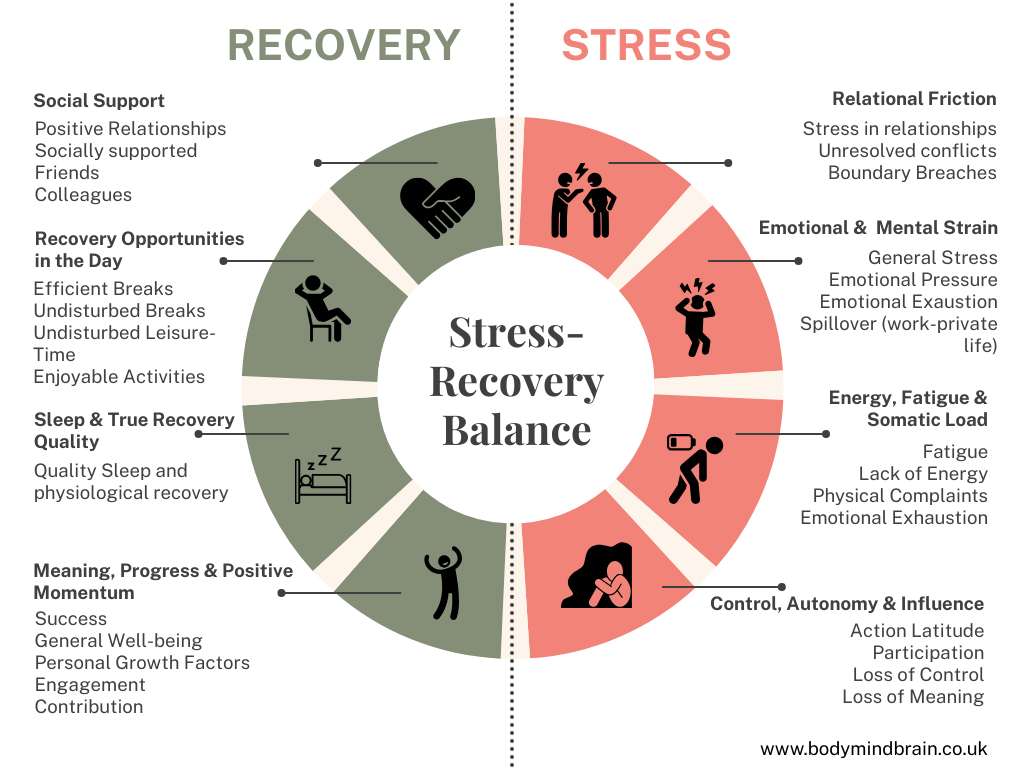
Stress (and performance drift) rarely comes from one thing. It tends to build when several areas fall out of balance and recovery isn’t keeping pace. In this approach, we consider stress load and recovery resources together.

This is a graphic showing the domains typically covered in a stress and recovery psychology for perforamance approach

Take the First Step

Who this is for

This is for you if:

  • You’re capable and motivated, but recovery no longer happens automatically

  • You want to look at how your thoughts, choices and boundaries can support you
  • You feel “switched on” too much of the time (even when you’re at rest)

  • Sleep, energy, focus, or emotional steadiness are less consistent than they used to be

  • You want a science-led, structured approach that looks through a wide-angle lens at your performance, stress and recovery

  • You want a structured, science-led coaching process that translates stress physiology into practical changes you can sustain.

How The Process Works

1) See the full picture: Stress and Recovery

We start by assessing both sides of the equation, not only what’s happening in your life, but how your system is responding to it.

A key part of this is the RESTQ (Recovery–Stress Questionnaire): a structured way to map your current stress–recovery balance across life and performance factors. It gives us a clear baseline and helps pinpoint the specific recovery gaps that often sit underneath fatigue, tension, irritability, flatness, or difficulty switching off.

Alongside this, we identify your personal stress signals, energy dips, sleep quality, decision fatigue, body tension, mood changes, and the thinking patterns or habits that keep you under-recovered.

We will make a clear plan for the next 2–4 weeks, so you leave knowing exactly what to implement.

Outcome: clarity on what’s costing you most, what’s restoring you least, and where the leverage is.

2) Make recovery proportionate to demand

Most people don’t need more motivation. They need a recovery plan that matches the reality of their life’s demands and stops them borrowing from tomorrow.

Together we build a rhythm you can sustain, such as:

  • Sleep quality: realistic wind-down routines and consistent sleep windows

  • Energy + cognitive load: micro-breaks, decision windows, and protecting mental bandwidth

  • Emotional load: reducing urgency and reactivity

  • Work strain + open loops: planning, boundaries, closing loops, and building tolerance for uncertainty

  • Social stress + social recovery: finding balance between relationships that drain and those that replenish you

  • Physical signals + physical recovery: decompression resets, tension release, technologies that support parasympathetic balance

  • Wellbeing + positive momentum: steadying routines, meaning, enjoyment, and progress you can feel

3) Re-train body and mind (because recovery is adaptation)

Recovery isn’t just rest. It’s the ability to shift state, restore, and rebuild capacity.

The core work is coaching. We use evidence-informed tools to reduce unhelpful stress loops, improve emotional regulation, and install recovery behaviours that protect focus, energy, and sleep in real life.

Optional: physiology-supported regulation
If you want additional support, we can add technology and training inputs that help your system settle and adapt more efficiently, such as:

  • Neurofeedback to support a steadier baseline and a more flexible stress response

  • IHHT (oxygen adaptation training) to support energy systems and physiological resilience

  • Strength and movement work (including EMS and somatic techniques) to reduce bracing patterns, restore mobility, and rebuild physical capacity

Each layer reinforces the others, but coaching remains the anchor so you are not relying on willpower (or sessions) to stay well.

4) Build capacity, not just relief

Short-term relief is valuable. But here the goal is increasing baseline capacity, physically, mentally, and emotionally, so future stress costs you less.

You’ll develop strategies and skills that help you:

  • adapt more efficiently

  • recover faster

  • stay composed under pressure

  • keep performance steady without sacrificing wellbeing

Optional: How technology can enhance regulation

If you are feeling especially stuck in high activation, depleted, or under-recovered, technology-supported regulation can support your nervous system to access a steadier baseline more quickly and more deeply, which can make coaching easier to implement.

Technology helps build a steadier baseline while coaching is what translates improved regulation into durable outcomes, such as:

  • better decisions under pressure

  • more consistent recovery behaviours

  • fewer self-generated stress loops (rumination, over-control, perfectionism, urgency)

  • clearer boundaries and workload design

  • sustainable habits that make the gains stick

The Result

A steadier, high-performing state where clarity, focus, and recovery coexist.

You’ll feel more capable and energised and more confident that you can meet challenges without burning yourself out.


About BodyMindBrain:

BodyMindBrain helps busy, midlife professionals break the cycle of stress and fatigue and rebuild the capacity to perform at their best.

This work is built on one integrated principle: stress is not just psychological; it’s systemic.
So we train the systems that drive resilience, including nervous system regulation, oxygen efficiency and recovery physiology, brain stability, physical strength, and metabolic flexibility.

Alongside the technologies, we rebuild the psychological and lifestyle foundations that sustain energy, protect long-term wellbeing, and keep performance stable when life is demanding.