Neurofeedback can seem like a complicated field to understand so here I will give you a basic introduction to the different types of Neurofeedback.
Two Types of Neurofeedback
I like to describe these as the two lineages that exists within the neurofeedback world and they represent two philosophies. One that allows the body and brain to self optimise according to its natural design and as a whole system and the other that fixes specific symptoms.
Nature endowed us with the ability to adapt and balance (homeostasis/ allostasis) and the brain and nervous system perform this function for us constantly and Dynamical Neurofeedback comes from this line of thinking and uses a more complex mathematical algorithm within its software. Linear neurofeedback on the other hand uses simpler mathematics and aims to fix specific symptoms
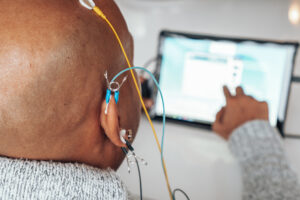
Both types of Neurofeedback are non invasive brain training techniques, which are intended to improve health and wellbeing. In order to be classified as neurofeedback, it must have a way to read the electrical activity of the brain via EEG (electroencephalography) and then to relay information back to the brain, usually visual or auditory, so that the activity of the brain is changed in some way. There are different approaches to neurofeedback some which require conscious effort in the change process and some which do not.
Non-Linear / Dynamical
Non-linear neurofeedback is different to the linear approach because with this approach, it is the brain that chooses to make its own changes. Nature endowed us with the ability to adapt and balance (homeostasis/ allostasis), and the brain and nervous system perform this function for us constantly outside of our awareness. Our brain can lose its balance, though, due to chronic and acute stressors, illness, accidents, injuries and genetic predispositions.
With Dynamical neurofeedback, the changes that occur during training are not directed or pushed towards a specific outcome but rather come about as the brain finds its way back to optimised function. As a result, this approach is safe and side effect-free and is making use of the brain’s natural capability for self-regulation. This approach is about optimising brain activity across the whole brain, every single frequency, rather than specific targeted ones as in the linear approach. No brain map or diagnosis is needed with this approach because it is a training for the brain to change itself, no clinician is driving a desired outcome.
With dynamical neurofeedback, the software uses its advanced mathematical algorithm to present feedback matched with millisecond-to-millisecond changes in brain activity. The feedback effectively holds up a mirror to the brain, prompting it to reassess and adjust its own activity. Any activity that is inefficient and out of balance will be autocorrected, and your brain will start to improve its performance in its own way, in its own time. Ultimately, this training helps the brain to reclaim its natural ability to be flexible, adaptive and resilient and does not focus on one specific endpoint.
Linear/ Traditional
Most neurofeedback systems attempt to encourage the brain to move towards specific states, brain waves and outcomes. This process it referred to as linear or traditional neurofeedback and it uses a simpler type of mathematics within its software.
Linear neurofeedback works by having a neurofeedback trainer first take a map of the brain’s electrical patterns. This map allows the trainer to analyse brain activity, e.g., to see whether your Theta brainwaves are low or Alpha too high compared with the patterns of an average brain. This mapping is called a qEEG- a Qualitative Electroencephalography. The map is then used as a reference point for the trainer to set protocols to help the brain migrate towards statistically average brain wave patterns, in order to diminish unhelpful patterns. A clinical diagnosis, such as ADHD or anxiety, can also be used to set the protocols.
The skills of the clinician are very important with this approach because errors in adjusting frequencies, i.e., over- or under-training of different frequencies, can create side effects. It is the clinician who will be making many adjustments to counterbalance side effects and keep the brain migrating towards the desired end state. This approach also takes effort from the trainee because there is usually some task for the trainee while the training takes place.
The Type of Neurofeedback we use at BodyMindBrain
At BodyMindBrain we use Dynamical Neurofeedback. The system called is NeurOptimal and we absolutely love the results that we see. Very consistently it promotes, a calmer, clearer mind, increased focus, better decision making and much less stress and anxiety.
Please click here to read about NeurOptimal Sessions